
RORO, container or flat-rack: how used machinery is shipped by sea
2026-11-14
Machines that can move on their own wheels or tracks usually go RORO; small ones fit a container; wide or tall ones go on a flat-rack. A comparison of the three.
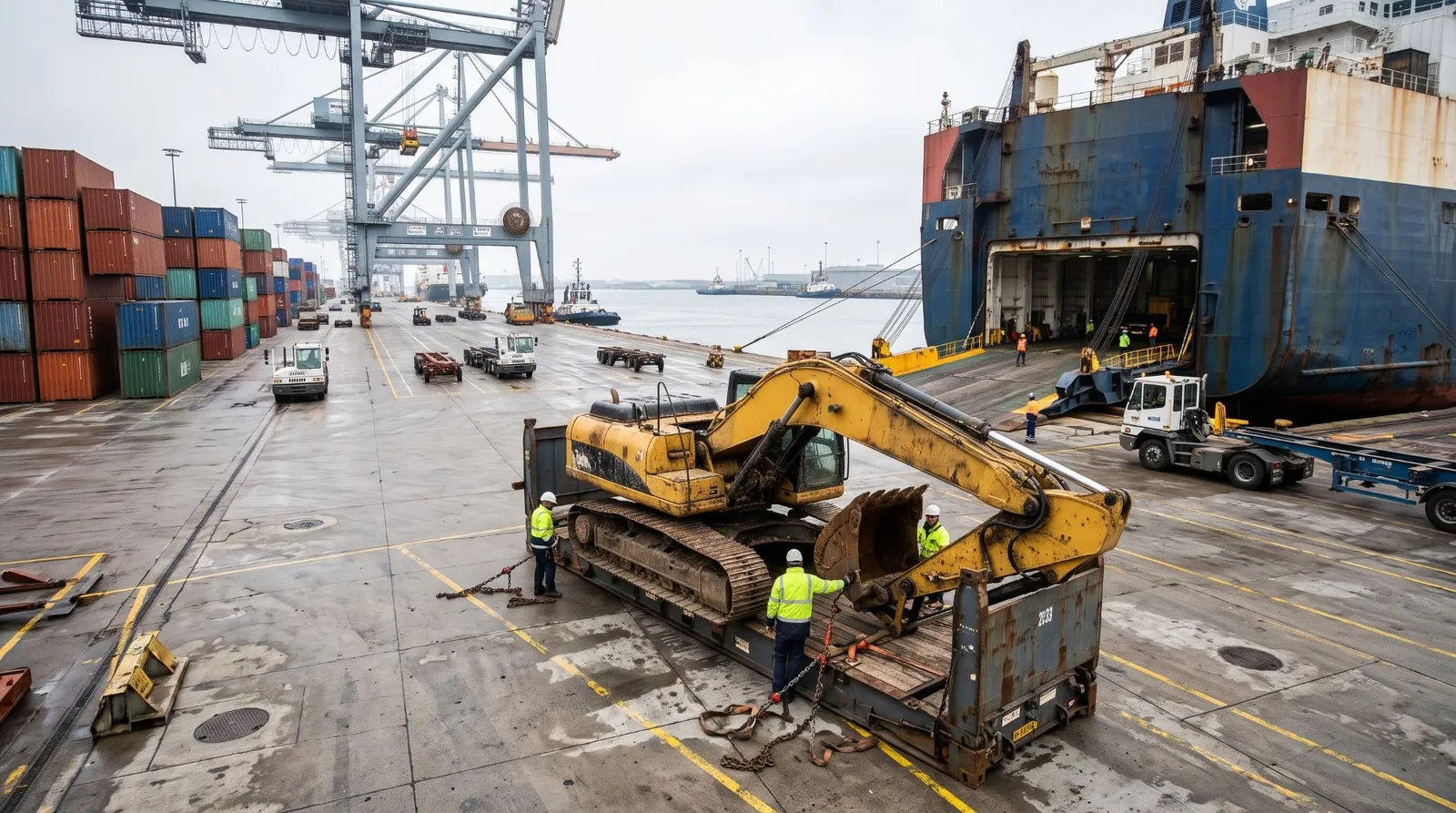
Which way a machine ships by sea depends on two questions: can it move by itself, and does it fit inside a container? The answer picks one of three methods.
| Method | Best for | How the machine gets on board |
|---|---|---|
| RORO | Machines that drive: tractors, wheel loaders, excavators | Driven up the ship's ramp |
| Container | Small machines, attachments, spare parts | Loaded and lashed inside a closed container |
| Flat-rack | Machines too wide or too tall for a closed container | Lifted onto an open platform container and lashed |
RORO: roll-on/roll-off
On a RORO vessel, cargo rolls on and off over a ramp. Inside, the decks are connected by ramps, and each machine stands on a deck that suits its weight and height, lashed in place.
Self-propelled machines, such as tractors, roll on and off on their own wheels. Nothing is lifted by crane, and the machine travels below deck, out of the weather.
Container
A standard shipping container is a closed steel box. It suits compact machines, such as mini excavators, and anything that travels with a machine: buckets, attachments and spare parts. The limit is the door: the machine has to fit through it, so wide machines are ruled out.
Flat-rack
A flat-rack is a container without side walls or a roof. Because it is open, the cargo can be wider and taller than a closed container allows.
A flat-rack travels on a container ship, so it reaches ports that RORO lines do not call at.
How we choose
The method follows from the machine and the destination: whether the machine drives, its width, height and weight, and which shipping lines call at the port. Where the destination can be reached overland, we deliver by road instead. Tell us the unit and where it is going, and we will say which method applies and what it costs. Send an inquiry or see the export process.